
We use cookies to improve your experience. By continuing to use our site, you agree to our use of cookies.
When drivers think about winter car maintenance, batteries and tyres usually take top billing. However, your engine’s cooling system plays an equally critical—and often overlooked—role during freezing Cambridgeshire winters. A neglected cooling system can lead to catastrophic engine damage, leaving you stranded with a massive repair bill just as the cold weather sets in.
Understanding how coolant works and ensuring your system is flushed and refilled with the correct antifreeze mix is essential protection for any vehicle in St Neots, Eaton Socon, and the surrounding areas.
Although the terms are often used interchangeably, there is a distinct difference:
Without adequate antifreeze, pure water in your cooling system would freeze inside the engine block during sub-zero nights. Because water expands when it freezes, it can crack engine blocks, burst radiators, and rupture heater cores—resulting in complete engine failure.
Coolant doesn’t just sit there regulating temperature; its protective chemical additives degrade over time due to heat cycles and age.
As coolant breaks down or gets diluted by plain tap water over time, its freezing point rises. Fresh coolant protects your engine down to around -37°C, but degraded fluid can begin freezing at just -2°C or -3°C.
Antifreeze contains anti-corrosion inhibitors designed to protect copper, aluminum, cast iron, and rubber components inside your cooling system. As these inhibitors break down, rust and scale accumulate, clogging small passages in the radiator and heater matrix.
Old coolant becomes acidic over time, slowly eating away at rubber hoses, water pump seals, and head gaskets from the inside out. A coolant flush removes stale fluid, flushes out scale and rust deposits, and restores protective inhibitor levels.
Before deep freeze temperatures arrive across PE19, keep an eye out for these warning indicators:
| Symptom | Potential Cause | Urgency Level |
|---|---|---|
| Cold Air from Heaters | Air lock or blocked heater matrix | Moderate – Needs inspection |
| Discoloured/Rusty Fluid | Degraded inhibitors & internal rust | High – System flush recommended |
| Temperature Gauge Rising | Failing water pump or thermostat | Immediate – Stop driving safely |
| Sweet Smell Under Hood | Minor coolant leak onto hot engine | High – Pressure test required |
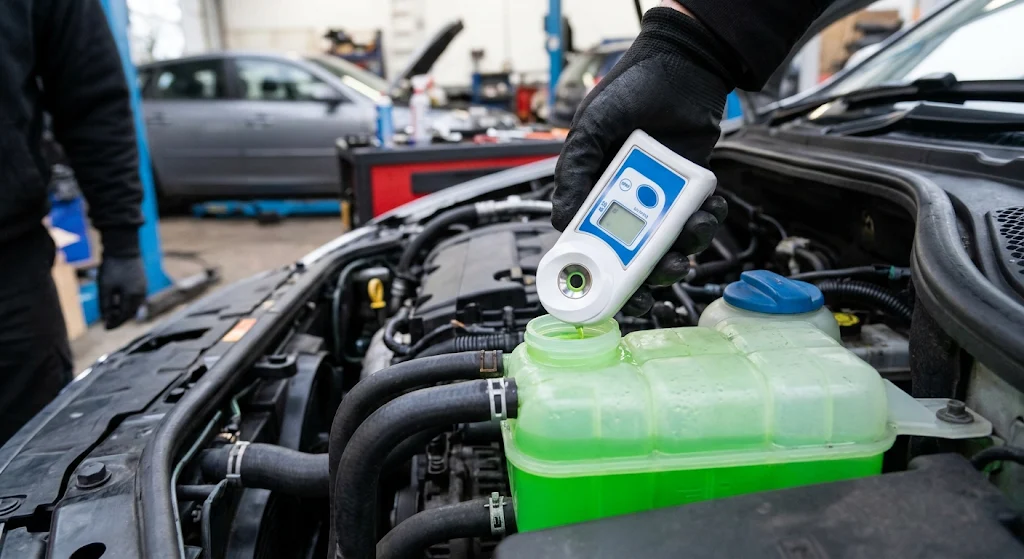
At Prestige Auto Solutions, we test your coolant strength using digital refractometers to measure its exact frost protection level. If a top-up or full system flush is required, we use exact OEM-approved coolant formulations tailored to your vehicle’s specific manufacturer requirements.
Protect your engine before the winter freeze hits. Pop into our Eaton Socon workshop or contact our team to book a winter fluid inspection today.



Enter your registration number, and we’ll automatically find your vehicle details to get you started.
MOT Expiry: